
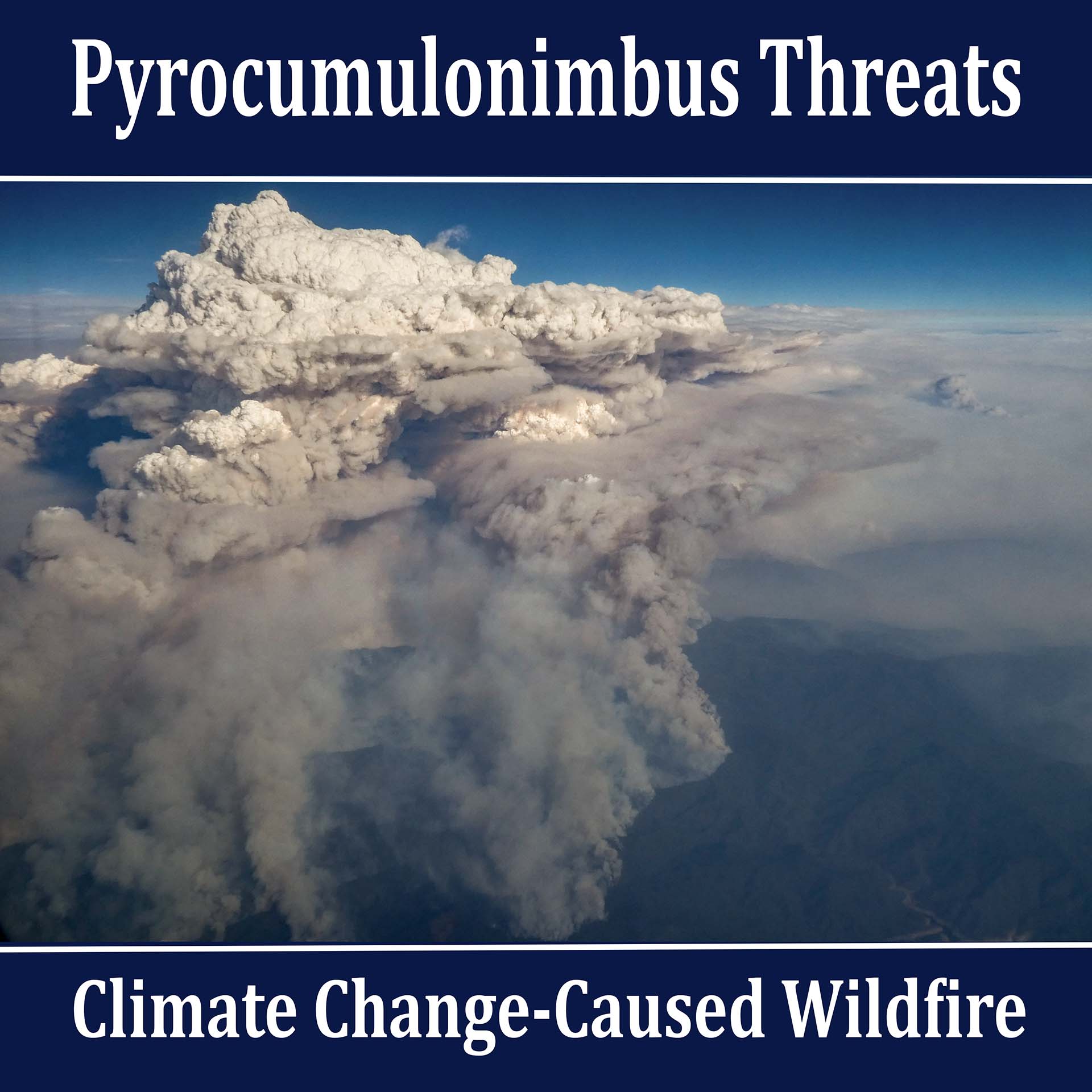

Pyrocumulonimbus Threats from Climate Change-Caused Wildfire
They rain lightning, not rain
Starting fires 22 miles away
Their fire tornados are far more extreme than fire devils
With as much energy as a moderately-sized volcanoes
Puncturing the stratosphere with deep convection
Like nuclear winter modeling
Pyrocumulonimbus (pyroCbs) events appear to be increasing dramatically, producing more energy, and erupting in places where they have never been seen before. No one knows what the rate of increase is for pyroCbs. (Yale Environment 360) The pyroCb events in Australia in the Black Summer Fires of 2019-2020 created a hole in the ozone layer generating “an unprecedented perturbation of stratospheric composition, dynamical circulation and radiative balance.” Since 2020 our planet has warmed a third of all warming prior to 2020, back to 1850. Warming nonlinearly contributes to extreme conditions that make extreme wildfire possible, that create these pyroCb events with unknown consequences. This quote above, “an unprecedented perturbation of stratospheric composition, dynamical circulation and radiative balance,” has very meaningful implications for the welfare of life on our planet with one team of researchers comparing their impacts to modeling of nuclear winter. It’s like Scotty telling Captain Kirk, “But Captain! You just can’t go’ round changing the laws of physics!” Our stratosphere is what cools our planet. If we go about injecting extremely large amounts of dark carbon and CO2 into the stratosphere, like repeated medium sized-volcanic eruptions (or much bigger with further warming from 2020), how will the stratosphere respond? This is a very new subject and likely one that we do not want to test as in, we need to prioritize restoring our climate in an emergency manner, so as to avoid an unintended test of stratospheric resilience on warmer planet.
Australian fires of 2020 created an unprecedented puncture of the stratosphere with a smoke column 50 percent higher than the tallest thunderstorm ever recorded and a 700 mile-wide ozone hole that persisted for thirteen weeks. The smoke persisted for 13 weeks generating an average cooling effect across the globe similar to a medium size volcanic eruption…
“The Australian bushfires around the turn of the year 2020 generated an unprecedented perturbation of stratospheric composition, dynamical circulation and radiative balance. Here we show from satellite observations that the resulting planetary-scale blocking of solar radiation by the smoke is larger than any previously documented wildfires and of the same order as the radiative forcing produced by moderate volcanic eruptions. A striking effect of the solar heating of an intense smoke patch was the generation of a self-maintained anticyclonic vortex measuring 1000 km in diameter and featuring its own ozone hole. The highly stable vortex persisted in the stratosphere for over 13 weeks, travelled 66,000 km and lifted a confined bubble of smoke and moisture to 35 km altitude. Its evolution was tracked by several satellite-based sensors and was successfully resolved by the European Centre for Medium- Range Weather Forecasts operational system, primarily based on satellite data. Because wildfires are expected to increase in frequency and strength in a changing climate, we suggest that extraordinary events of this type may contribute significantly to the global stratospheric composition in the coming decades.”
Khaykin et al,. The 2019 to 20 Australian wildfires generated a persistent smoke-charged vortex rising up to 35 km altitude, Nature Communications Earth and Environmental, September 21, 2020.
https://www.nature.com/articles/s43247-020-00022-5.
Australia’s Black Summer pyrocumulonimbus events behaved similar to modelling of nuclear winter… Extreme fire from warming has created unprecedented pyrocumulonimbus activity, especially those that persist at night. Deep stratospheric injection of smoke behaves similarly to nuclear winter modeling. “Dramatic shifts in stratospheric composition, radiative balance, and even regional circulation now appear possible from extreme pyroCb events. Given the prospects of continuing climate change, and the increasing intensity of severe fire seasons globally, pyroCb research is entering a new phase focused on reconciling larger scales of potential atmospheric impacts and climate feedbacks.”
(Abstract) “The Black Summer fire season of 2019–2020 in southeastern Australia contributed to an intense ‘super outbreak’ of fire-induced and smoke-infused thunderstorms, known as pyrocumulonimbus (pyroCb). More than half of the 38 observed pyroCbs injected smoke particles directly into the stratosphere, producing two of the three largest smoke plumes observed at such altitudes to date. Over the course of 3 months, these plumes encircled a large swath of the Southern Hemisphere while continuing to rise, in a manner consistent with existing nuclear winter theory. We connect cause and effect of this event by quantifying the fire characteristics, fuel consumption, and meteorology contributing to the pyroCb spatiotemporal evolution. Emphasis is placed on the unusually long duration of sustained pyroCb activity and anomalous persistence during nighttime hours. The ensuing stratospheric smoke plumes are compared with plumes injected by significant volcanic eruptions over the last decade. As the second record-setting stratospheric pyroCb event in the last 4 years, the Australian super outbreak offers new clues on the potential scale and intensity of this increasingly extreme fire-weather phenomenon in a warming climate.”
Peterson et al., Australia’s Black Summer pyrocumulonimbus super outbreak reveals potential for increasingly extreme stratospheric smoke events, Nature Climate and Atmospheric Science, July 13, 2021.
https://www.nature.com/articles/s41612-021-00192-9
Pyrocumulonimbus, Pyroconvective: Rivalling or exceeding those in tornadic supercell thunderstorms… “Massive wildfires (i.e., megafires) produce enough heat to generate powerful updrafts that are as strong as those observed during tornadic supercell thunderstorms. Weather radar data show that these updrafts are as strong as 130 mph… and even contribute to deadly fire‐generated vortices (firenadoes)… [Updrafts] can be extreme, reaching at least 58 m s−1, more than double previous estimates (Banta et al., 1992) and rivaling those in tornadic supercell thunderstorms, for which updraft speeds of 20–55 m s−1… The magnitude and width of the observed updrafts have important implications for fire behavior. First, mass continuity requires strong inflow winds to replace the evacuated updraft air. These inflows are poorly understood yet can have a profound impact on the rate and direction of fire spread. Second, updrafts of this magnitude can loft large burning debris capable of initiating “spot fires” that merge to form “mass fire,” which can feedback on fire intensity (Finney & McAllister, 2011). Third, these updrafts may help stretch, tilt, and twist fire‐generated and ambient sources of vorticity, providing a pathway to tornado‐strength vortices in wildfire plumes… We conclude by noting that extreme pyroconvective updrafts are also a previously undocumented aviation risk. Upon penetrating the 35 m s−1 updraft in the flanking plume (Figures 3a and 3b), the UWKA experienced a dramatic vertical displacement, injuring a flight scientist. Similarly, a Qantas Airlines flight en route to Canberra, Australia, was forced to make an emergency landing after encountering extreme turbulence in a developing pyroCu/Cb in January 2020 (Black & Hayne, 2020). Both the UWKA and Qantas pilots indicated their weather‐avoidance radars did not alert them to these hazards, likely due to the low radar reflectivity of the pyrometeors (e.g., 25 dbZ in the updraft Figure 1c), as compared with the high reflectivity (50–75 dbZ) in precipitation‐loaded thunderstorm updrafts, which are a well‐known aviation hazard (Allen, 2013). Both pilots also reported dramatic reductions in ambient light within the plumes (i.e., nearly black), consistent with previous research flights documenting radiances reduced by several orders of magnitude in pyroCu plumes (Gatebe et al., 2012).”
Rodriguez et al., Extreme Pyroconvective Updrafts During a Megafire, Geophysical Research Letters, September 9, 2020.
https://www.researchgate.net/publication/346573430_Extreme_Pyroconvective_Updrafts_During_a_Megafire
Australia – CBS News –
https://www.cbsnews.com/news/fires-in-australia-pyrocumulonimbus-thunderstorm-clouds-victoria-sydney/
NASA – https://www.nasa.gov/topics/earth/features/pyrocb.html