
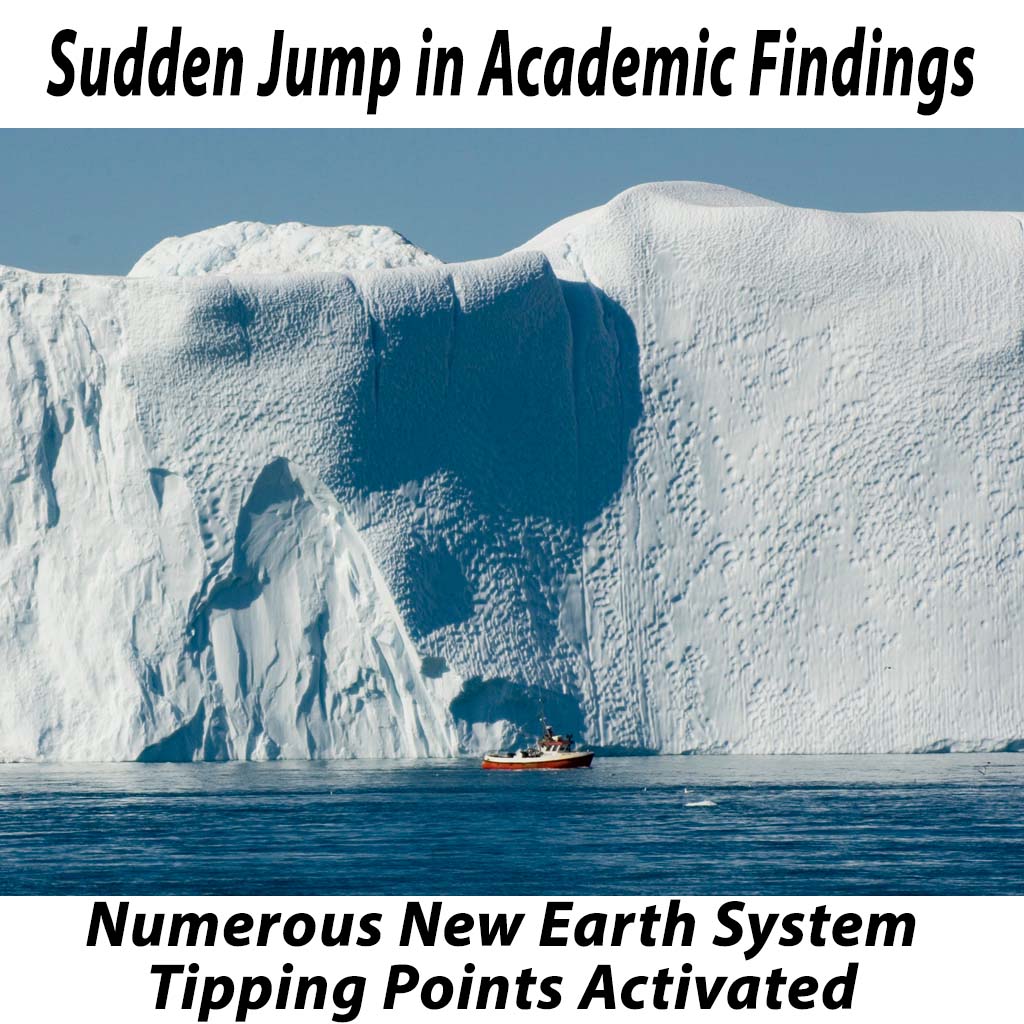

Findings since mid-May reveal new and more serious insight into tipping threshold crossing of the Antarctic and Greenland Ice Sheets, Antarctic sea ice, ocean acidification, and tropical and boreal forests.
The 30 percent warming jump in 2023 and 2024 is crucial to understanding the extreme risks of our current and rapidly accelerating climate trajectory. But this is only a part of the story. The Earth systems degradation that is ongoing, otherwise known as Earth systems climate tipping responses, have been building since we warmed beyond the natural variation of our old climate, which is the same thing as warming beyond the evolutionary boundaries of our Earth systems. Once warming or other warming effects (drought, ocean acidification, forest mortality, coral mortality, etc.) become different than they were during the evolution of our Earth systems, degradation begins that does not stop until the thing that caused it to begin is removed. Here is where we find ourselves today – much farther along than modeling has projected for over 30 years.
The critical thing to understand about systems degradation is that unless the thing that caused it is removed, the degradation continues and literally becomes more severe even if all warming was stopped. This is because of feedbacks within the systems and the forest mortality feedback is an example. As tree mortality increases, more forest floor is exposed to direct sunlight creating greater forest floor warming and moisture evaporation. This moisture stress “feeds back” into more tree mortality, which continues the feedback loop. An additional feedback occurs when carbon (greenhouse gases) from the diminished forest is emitted, causing more warming. An even further feedback occurs because the diminished forest absorbs fewer greenhouse gases.
The solution therefore is not elimination of emissions as this only reduces future warming. It is current warming from historic emissions that has created the Earth systems degradation.
To stabilize, we must remove the current warming that is causing all the mayhem, or cool earth rapidly – far more rapidly than the end of century scenarios of our current climate culture. This something complete elimination of humankind’s emissions cannot do as this would only decrease future warming. If we do not cool rapidly (generally by mid-century with most tipping elements), degradation becomes so severe that collapse and or reorganization of the system(s) is foregone. Generally, degradation alone flips a system from absorbing greenhouse gases to emitting them, and here arises another feedback of tremendous proportions. The emissions that our Earth systems are capable of, of systems that have already been identified as having exceeded their tipping boundaries; these emissions will dwarf humankind’s very rapidly.
This urgency, that has previously only been identified as occurring in the later part of the century with the worst-case scenarios, is where we find ourselves today, far ahead of projections, like almost all other climate effects to date. (https://climatediscovery.org/Impacts_Happening_Ahead_of_Projection_051223.docx)
In 2020, Sierra Club adopted new climate policies, one of which was to support geoengineering in case emergency cooling was needed. Five years leather, emergency cooling is needed – this is the bad news. The scientific findings on the progression of the collapses of Earth systems as defined in the recent acceleration of findings makes this distinctly clear. The good news is that geoengineering is literally not how we will address this developing emergency.
Geoengineering is what we have been doing to planet Earth for 8,000 years, beginning with the clearing of a third of the world’s forests by 3,000 years ago and introduction of agriculture that created further emissions from deforestation and loss of forest sequestration. By 200 years ago and the advent of burning fossil fuels, we had removed half of our forests and today we have removed two-thirds of our forests for a total greenhouse gas emissions of 1,700 gigatons as of CO2 equivalents not including lost sequestration. The total human emissions from fossil fuels, agriculture and other land uses since the industrial era began about 200 years ago is 2,500 gigatons of CO2 equivalents. These “early Anthropocene emissions,” or the human-caused emissions that have happened in this new era where humans are reshaping planet Earth is fundamental in understanding what geoengineering really is and how we are going to mitigate for it’s effects.
The solution to this tremendous geoengineering problem we have created over the last 8,000 years is not geoengineering, regardless of what the body of science has labelled these solutions. The solutions are to reduce or eliminate emissions, remove historic emissions from our sky that are causing all the mayhem, and use temporary emergency cooling solutions to temporarily mask the warming to prevent tipping processes from becoming irreversible. These solutions are not dangerous relative to the danger we face from not restoring our climate promptly. What is dangerous is allowing our climate to continue upon its current trajectory where tipping collapses will create natural feedback emissions that dwarf humankind’s.
Antarctic Sea Ice
Antarctic sea ice coverage has taken a “markedly” strong, and “dramatic” downturn in coverage, plausibly indicating a new state is developing that significantly amplifies global warming with feedback effects to the Antarctic Ice Sheet. See –
Silvano et al., Rising surface salinity and declining sea ice, A new Southern Ocean state revealed by satellites, PNAS, June 30, 2025.
https://www.pnas.org/doi/10.1073/pnas.2500440122
Note: This is happening while Arctic sea ice extents is at a new record low.
Antarctic and Greenland Ice Sheets
Ice loss from Greenland and Antarctica has quadrupled since 199. These findings conclude that we passed the tipping point of these two system with warming of about 1 degree C above normal, where we are 1.5 degrees C above normal today. The authors state, “Here we synthesise multiple lines of evidence to show that +1.5 °C is too high and that even current climate forcing (+1.2 °C), if sustained, is likely to generate several metres of sea-level rise over the coming centuries, causing extensive loss and damage to coastal populations and challenging the implementation of adaptation measures. To avoid this requires a global mean temperature that is cooler than present and which we hypothesise to be closer to +1 °C above pre-industrial, possibly even lower, but further work is urgently required to more precisely determine a ‘safe limit’ for ice sheets.”
Stokes and Deconto, Warming of +1.5 degrees C is too high for polar ice sheets, Nature Communications, Earth and Environment, May 20, 2025.
https://www.nature.com/articles/s43247-025-02299-w
Ocean Acidification
The authors’ abstract states, “by 2020, the average global ocean conditions had already crossed into the uncertainty range of the ocean acidification boundary… Up to 60% of the global subsurface ocean (down to 200 m) has crossed a critical ocean acidity boundary.”. The authors continue, “Large portions of the subsurface have already changed significantly from pre-industrial conditions.” The study finds impacts are already occurring, that “Loss of ecosystem function or suitable habitats can lead to fragmentation, the breaking up the continuous distribution of a species into smaller, isolated patches. This fragmentation directly reduces population connectivity, as individuals within the fragmented habitats have reduced opportunities for interaction, mating and dispersal.”
Findlay et al., Ocean Acidification – Another Planetary Boundary Crossed, Global Change Biology, June 9, 2025.
https://onlinelibrary.wiley.com/doi/10.1111/gcb.70238
Tropical and Boreal Forests
The authors show that our commonly understood 1.5 degree C warming target, which is our current level of warming, risks unavoidable impacts, meaning that warming pof 1.5 C is to high for our forests with risks of foregone collapse or tipping. (Abstract) “With global warming heading for 1.5 °C, understanding the risks of exceeding this threshold is increasingly urgent. Impacts on human and natural systems are expected to increase with further warming and some may be irreversible. Yet impacts under policy-relevant stabilization or overshoot pathways have not been well quantified. Here we report the risks
of irreversible impacts on forest ecosystems, such as Amazon forest loss and high-latitude woody encroachment, under three scenarios that explore low levels of exceedance and overshoot beyond 1.5 °C. Long-term forest loss is mitigated by reducing global temperatures below 1.5 °C. The proximity of dieback risk thresholds to the bounds of the Paris Agreement global warming levels underscores the need for urgent action to mitigate climate change—and the risks of irreversible loss of an important ecosystem.”
Munday et al., Risks of unavoidable impacts on forests at 1.5 degrees C with and without overshoot, Nature Climate Change, May 12, 2025.
https://www.nature.com/articles/s41558-025-02327-9
Bruce Melton is the director of the oldest independent climate science education organization in the world, one who single-handedly caused Sierra Club to lower their warming target from the globally ubiquitous further warming to 1.5 degrees C above normal, to a restoration target of cooler than today, back to within the evolutionary boundaries of our Earth system; and one who daily works with numerous climate scientists around the world in an urgent attempt to redefine our climate culture’s vision and policy to restoration instead of further warming, things are getting out of control.